

 English
 русский
 Español
 عربى
عربى
Content
- 1 Why Aluminum Is the Preferred Material for Colored Rain Gutters
- 2 How the Color Finish Is Applied: Powder Coating Technology
- 3 Available Color Options and Custom Matching
- 4 Color Longevity and Weather Resistance
- 5 System Components and Installation Advantages
- 6 Matching Colored Aluminum Gutters to Different Architectural Styles
Why Aluminum Is the Preferred Material for Colored Rain Gutters
Aluminum has dominated the rain gutter market for decades, and the reason comes down to a combination of properties that no competing material fully replicates. Its specific gravity of approximately 2.7 makes it significantly lighter than steel or copper, which reduces structural load on fascia boards and simplifies installation without sacrificing the rigidity a functional gutter system requires. More importantly for colored applications, aluminum's surface chemistry works in its favor: when exposed to air, it naturally forms a thin, invisible oxide layer that acts as a self-sealing barrier against corrosion. This passive protection continues for the lifetime of the product, even in coastal, industrial, or high-humidity environments where other metals would degrade within years.
Steel gutters can be painted and powder-coated, but they remain vulnerable to rust once that coating is scratched or compromised — particularly at cut ends and fastener points. Copper develops a patina over time that many homeowners find attractive, but its color cannot be controlled, and the material cost is substantially higher. Vinyl gutters are inexpensive but limited to a handful of factory colors, cannot be custom-matched, and become brittle in freezing temperatures. Manganese aluminum alloy roof gutter options take the base advantages of aluminum further by incorporating manganese for improved tensile strength — relevant for systems installed in regions with heavy snow loads or strong wind exposure.
For any project where color consistency across the full gutter system matters — gutters, downspouts, elbows, miters, and accessories — aluminum is the only material that makes custom color matching practically and economically feasible at scale.
How the Color Finish Is Applied: Powder Coating Technology
The color on a quality colored aluminum rain gutter is not paint in the conventional sense. Electrostatic powder coating is a two-stage finishing process that produces a fundamentally different result from liquid paint application. In the first stage, dry pigment powder is given an electrostatic charge and sprayed onto the grounded aluminum surface. The charge causes the powder to adhere uniformly across the entire profile — including edges, corners, and recesses where liquid paint commonly runs thin or drips. The coated aluminum then passes through a curing oven, where heat causes the powder to melt and flow into a continuous, chemically bonded film.
The practical consequences of this process are significant. Adhesion strength is substantially higher than liquid paint because the coating bonds at a molecular level with the aluminum surface rather than simply sitting on top of it. Coating thickness is consistent across the full profile — typically 60–80 microns — which means color uniformity is the same on a flat face as it is on a curved edge or an inside corner. The cured finish is also harder than liquid paint, offering better resistance to scratching during handling, transportation, and installation.
Temperature performance is another area where powder coating outperforms conventional paint. The cured film maintains adhesion and flexibility across a wide thermal range — typically from below -30°C to above 120°C — without cracking, peeling, or losing gloss. This matters for rain gutters, which are permanently mounted outdoors and subject to direct sun, freeze-thaw cycling, and thermal expansion across all four seasons. A finish that degrades under these conditions will show its age within three to five years; a properly applied powder coat maintains its appearance for decades.
Gloss level is also controllable through powder formulation. High-gloss finishes are available for homeowners who want a polished, reflective appearance, while satin and matte finishes suit more understated architectural contexts. Both deliver the same adhesion and durability characteristics — the difference is purely aesthetic.
Available Color Options and Custom Matching
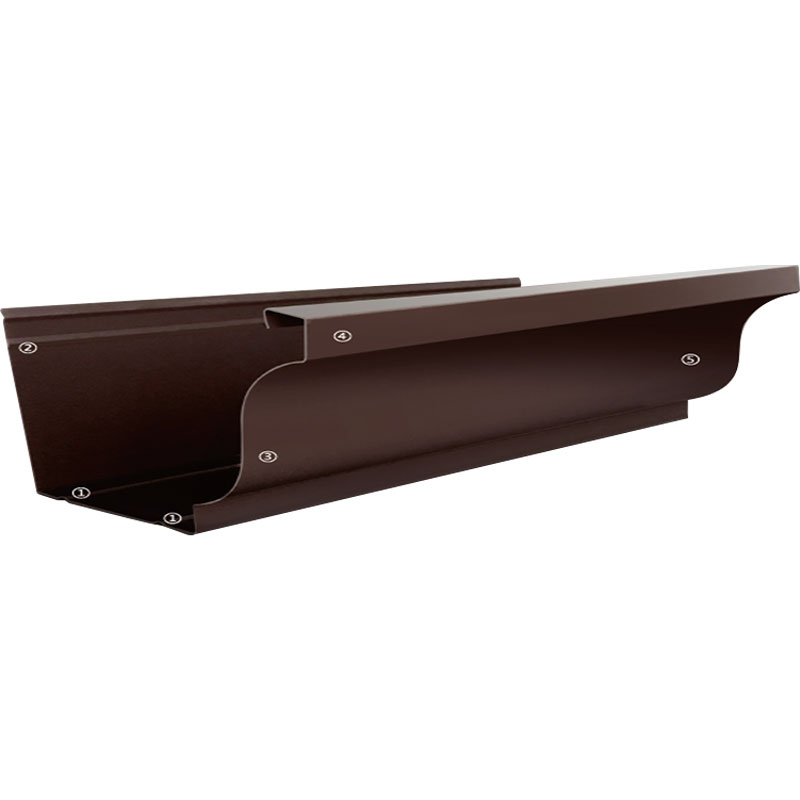
Standard colored aluminum rain gutter systems are available in a broad range of pre-finished colors that cover the most common architectural color families. White and off-white variants — including pure white, eggshell, almond, and cream — remain the most widely specified because they complement the widest range of exterior finishes and trim colors. Brown tones, from warm tan to deep musket brown and dark bronze, are the preferred choice for brick exteriors, wood-clad homes, and rustic or craftsman architectural styles. Gray and charcoal options address the growing demand from modern and contemporary construction, where neutral metallic tones complement fiber cement siding, zinc-coated roofing, and aluminum window frames.
Beyond standard colors, the complete colored aluminum rain gutter product range includes options for personalized color customization — the ability to specify a RAL, NCS, or Pantone reference and have the gutter system powder-coated to match. This capability is particularly valuable for commercial and residential projects where the architect or designer has specified an exact exterior color scheme and the gutter system needs to integrate seamlessly rather than approximate a match from a limited standard palette.
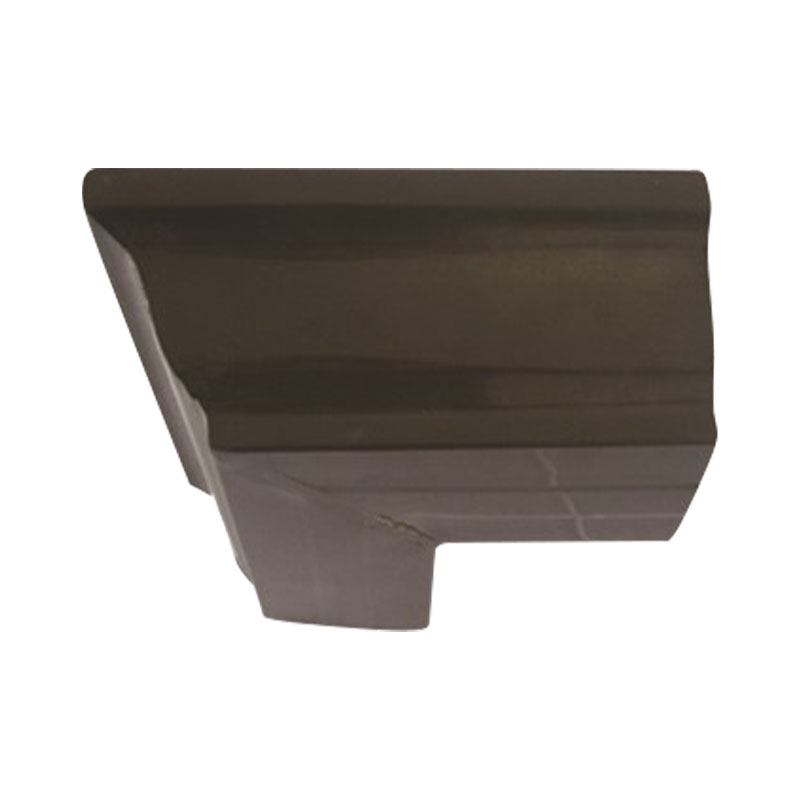
The customization extends beyond the main gutter profile. A coherent system requires that downspouts, elbows, end caps, outlets, and hangers all carry the same finish — visually inconsistent hardware is immediately noticeable on an otherwise well-coordinated exterior. Quality manufacturers color-match the full accessory range from the same coil stock used for the main gutter profile, ensuring that the finish, sheen level, and color reference are identical across every component.
| Color Family | Typical Shades | Best Suited For |
|---|---|---|
| White / Off-White | Pure White, Eggshell, Almond, Cream | Colonial, traditional, coastal, most light-colored exteriors |
| Brown / Bronze | Royal Brown, Musket Brown, Dark Bronze, Coppertone | Brick, wood siding, craftsman, rustic, earth-tone exteriors |
| Gray / Charcoal | Light Gray, Medium Gray, Charcoal, Tuxedo | Modern, contemporary, fiber cement siding, dark roofs |
| Black | Matte Black, Gloss Black | Modern farmhouse, industrial, high-contrast exteriors |
| Green | Forest Green, Grecian Green | Wooded settings, traditional homes with green trim |
| Custom | RAL / NCS / Pantone reference | Architect-specified projects, commercial, bespoke residential |
Color Longevity and Weather Resistance
Color retention over time is where the difference between a quality powder-coated aluminum gutter and a lesser alternative becomes most visible. UV radiation is the primary enemy of exterior coatings: prolonged sun exposure breaks down the chemical bonds in the pigment, causing gradual fading and chalking that makes a once-vibrant finish look dull and aged. Premium powder coat formulations used on aluminum gutters incorporate UV stabilizers that slow this degradation significantly — well-specified systems carry 20-year paint warranty coverage, a benchmark that conventional liquid-painted gutters rarely achieve.
The self-protective oxide layer that forms on bare aluminum also benefits the coated version. Should the powder coat be breached — by physical impact, an aggressive fastener, or an installation cut — the aluminum surface beneath does not corrode in the aggressive way that steel does. There is no rust propagation spreading beneath the surrounding coating, which is the failure mode that causes painted steel gutters to look deteriorated at joints and cut ends within a few years of installation. The aluminum simply forms its oxide layer at the exposed point and remains stable.
For projects in challenging environments, additional protective measures are available. How colored aluminum gutters ensure long-term color stability covers the specific coating technologies and maintenance practices that maximize system lifespan — relevant reading for specifiers working on coastal, industrial, or high-UV-exposure projects where standard residential performance benchmarks may not be sufficient.
Temperature cycling — the expansion and contraction of the aluminum profile through summer heat and winter cold — is managed by the inherent flexibility of the cured powder coat film. Unlike brittle coatings that crack at stress points over repeated thermal cycles, a properly formulated powder coat maintains adhesion across the full range of temperatures encountered in temperate and continental climates. The result is a finish that enters its twentieth year looking meaningfully closer to installation day than most competing finish systems.
System Components and Installation Advantages
A rain gutter system is only as effective as its weakest joint. The design principle behind a quality colored aluminum system is that every component — from the main gutter profile to the smallest accessory — is engineered to work together with precision tolerances, eliminating the gaps and misalignments that cause leaks, overflows, and premature failure. This matters practically because the most common source of gutter failure is not the gutter profile itself but the connections: end caps that don't seal, downspout outlets that allow water to bypass the profile, or miters that develop gaps as the building settles.
Seamless aluminum gutters — formed on-site from coil stock using a roll-forming machine — eliminate the factory seams present in sectional systems and therefore remove the most leak-prone joints from the horizontal gutter run entirely. The only joints in a seamless system are at corners, outlets, and end caps, each of which is sealed with compatible sealant and mechanical fasteners. This systematic approach to water management is what allows a well-installed aluminum gutter system to function without leaks or overflows for decades.
The color-matched accessory ecosystem is a practical benefit that often goes underappreciated during specification. Gutter accessories for color-matched systems — including elbows, downspout brackets, end caps, and splash blocks — carry the same powder coat finish as the main profile, so the installed system presents a consistent visual appearance rather than the mismatched hardware that results when accessories are sourced separately. Installation speed is also improved because component fit is guaranteed when the system comes from a single manufacturer; there is no field adjustment required to make accessories work with profiles from a different supplier.
Matching Colored Aluminum Gutters to Different Architectural Styles
The right gutter color reinforces the architectural character of a building rather than interrupting it. For contemporary residential construction — characterized by clean lines, large glass areas, fiber cement or metal cladding, and minimal ornamental detail — charcoal, matte black, or dark gray gutters reinforce the monochromatic palette that defines the style. Matching the gutter color to the window frames or the metal roofing profile creates a visually unified envelope where every element belongs to the same design language.
Traditional and colonial homes present a different brief. Here, the goal is typically integration rather than statement — gutters that align with the fascia and trim color so that the roofline reads as a single, cohesive element. White gutters on white trim achieve this invisibility effectively. For brick homes with cream or brown trim, almond or royal brown gutters provide a warm transition between the roofline and the masonry below without introducing a new color that the eye has to reconcile.
Commercial and institutional buildings often require a more deliberate approach. A retail or hospitality facade may use gutter color as part of a branded exterior palette, matching the system to specific corporate colors specified in a brand standards document. In these cases, the custom powder coat matching capability of aluminum gutter systems becomes essential — no standard color chart will contain the exact shade required, and the ability to specify against a Pantone or RAL reference is what makes aluminum the material of choice for this category of project.
Rustic, farmhouse, and mountain residential styles occupy a middle ground. Bronze, dark brown, and weathered copper-look finishes work well here because they reference natural materials — wood, stone, aged metal — that are already present in the palette. A dark bronze gutter against cedar shingles and a stone chimney reads as belonging; a white or gray gutter in the same context creates a contrast that the style doesn't call for. Selecting within the warm brown-to-bronze range for these projects is rarely a wrong choice, and the breadth of shades available in a quality aluminum color program gives designers the refinement to find the precise tone that works.