

 English
 русский
 Español
 عربى
عربى
Content
- 1 Why Aluminum Is the Ideal Material for Rain Gutters
- 2 Electrostatic Powder Spraying: The Technology Behind the Finish
- 3 Personalized Color Customization for Architectural Harmony
- 4 System Specifications: Styles, Materials, and Profile Options
- 5 Systematic Design That Eliminates Common Gutter Failures
- 6 Long-Term Value Compared to Alternative Gutter Materials
Why Aluminum Is the Ideal Material for Rain Gutters
When evaluating materials for a rain gutter system, aluminum consistently outperforms alternatives like steel, vinyl, and zinc across the criteria that matter most: weight, corrosion resistance, lifespan, and structural reliability. The colored aluminum rain gutter system takes these inherent advantages further by combining them with precision engineering and advanced surface finishing.
Aluminum's specific gravity is 2.7, making it significantly lighter than steel (7.8) while still delivering strong load-bearing performance. This low density greatly improves the safety of stress distribution across the roofline, reducing strain on fascia boards and mounting hardware. Buildings with longer eave spans benefit particularly from this — the structural load remains manageable without compromising gutter rigidity or drainage capacity.
A key property that sets aluminum apart is its natural self-protection mechanism. When exposed to air, a layer of oxide film that is invisible to the naked eye forms on the surface of metallic aluminum. This thin but highly stable film acts as a permanent barrier against moisture, oxygen, and environmental pollutants. Unlike iron-based metals that rust from the inside out, aluminum's oxide layer is self-renewing — if scratched, it reforms almost immediately. This makes aluminum extremely resistant to corrosion even in coastal, high-humidity, or industrial environments where other metals deteriorate rapidly.
Electrostatic Powder Spraying: The Technology Behind the Finish
The surface quality of a rain gutter system directly affects its long-term performance and aesthetic appeal. Standard painted finishes often peel, fade, or crack within a few years when exposed to UV radiation, thermal cycling, and rainfall. The colored aluminum rain gutter system addresses this through electrostatic powder spraying technology, a process that fundamentally changes how coatings bond to metal surfaces.
In electrostatic powder spraying, dry powder particles are electrostatically charged and then attracted to the grounded aluminum surface. The even charge distribution ensures that powder settles uniformly across the entire profile — including recesses, edges, and corners that liquid paint often misses. The coated part is then cured in an oven, causing the powder to melt and form a continuous, dense film.
The result is a finish with several measurable advantages over conventional liquid paint:
- Strong adhesion — the electrochemical bond between powder and aluminum resists chipping, peeling, and delamination far better than brush or spray-applied coatings
- Uniform coating thickness — typically 60–80 microns across the entire profile, eliminating thin spots that lead to premature corrosion
- High gloss retention — the cured powder maintains color vibrancy and surface sheen for years longer than liquid paint equivalents
- Resistance to severe cold and high temperatures — the cured film tolerates thermal extremes from below -30°C to above 120°C without cracking or discoloring
- No solvent emissions — powder coatings contain no VOCs, making them safer to apply and more environmentally responsible than solvent-based paints
For a rain gutter system that faces daily exposure to rain, sunlight, freezing temperatures, and thermal expansion cycles, this level of surface protection is not cosmetic — it is structural. A degraded coating accelerates oxidation at the metal surface and shortens the usable life of the entire system.
Personalized Color Customization for Architectural Harmony
One of the most significant limitations of traditional gutter systems is their narrow color range — typically white, brown, or mill-finish aluminum. For architects, developers, and homeowners who invest in a coherent exterior design, standard gutter colors create visible mismatches that undermine the overall appearance of the building.
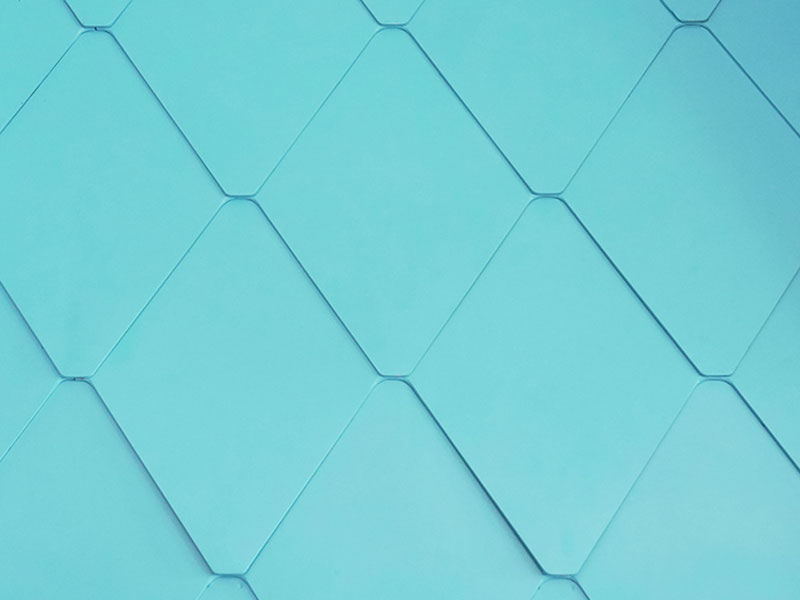
The colored aluminum rain gutter system solves this through personalized color customization. Using the full RAL and Pantone color standards as references, gutters can be finished in virtually any color required to achieve precise color matching of the building's eaves, roofs, exterior walls, and trim. This allows gutters to blend seamlessly with the facade — or to serve as a deliberate architectural accent, depending on the design intent.
Custom color specification is particularly valuable in the following scenarios:
- Heritage and period architecture where specific muted tones are required to match traditional materials
- Contemporary buildings with dark cladding systems — such as charcoal, anthracite, or deep grey facades — where white gutters create stark visual contrast
- Commercial developments with brand-aligned color schemes that extend across all exterior elements
- Residential projects with bespoke roof tile colors that require coordinated gutter tones to complement each other cohesively
Because the color is applied via electrostatic powder spraying before installation, the finish is factory-controlled and consistent across every component — gutters, downpipes, brackets, and end caps all carry the same color depth and gloss level, ensuring visual uniformity across the complete installation.
System Specifications: Styles, Materials, and Profile Options
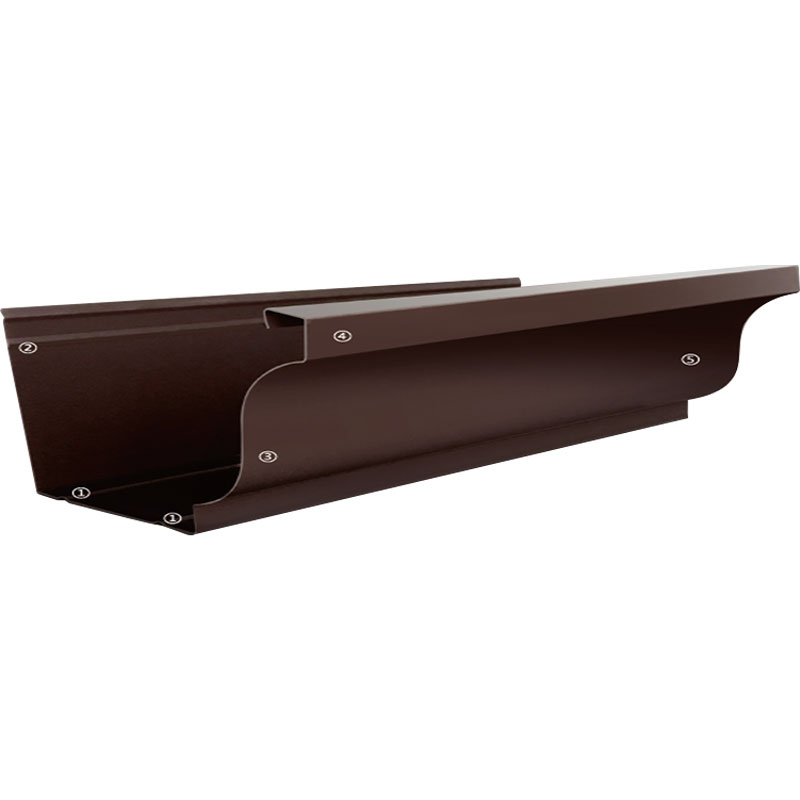
A well-designed rain gutter system must accommodate the full range of roof geometries, drainage volumes, and architectural contexts encountered across different building types. The metal rain gutter system covers a variety of materials, diverse styles, and complete specifications, with product shapes engineered to meet different architectural styles — from traditional pitched roofs to modern flat-roof extensions.
The table below outlines the most common profile types and their recommended applications:
| Profile Type | Cross-Section | Best Application |
|---|---|---|
| K-Style (Ogee) | Flat back, decorative front | Residential, high water volume |
| Half-Round | Semicircular trough | Heritage, traditional architecture |
| Box (Square) | Rectangular trough | Commercial, industrial, modern builds |
| European Style | Wide, low-profile trough | Contemporary residential and villa |
Standard widths range from 100 mm to 200 mm for gutters, with matching downpipe diameters from 75 mm to 120 mm. Custom dimensions are available for large-span commercial roofs or unusually high rainfall catchment areas. All profiles are manufactured from aluminum alloy to consistent wall thickness tolerances, ensuring predictable performance across the full system.
Systematic Design That Eliminates Common Gutter Failures
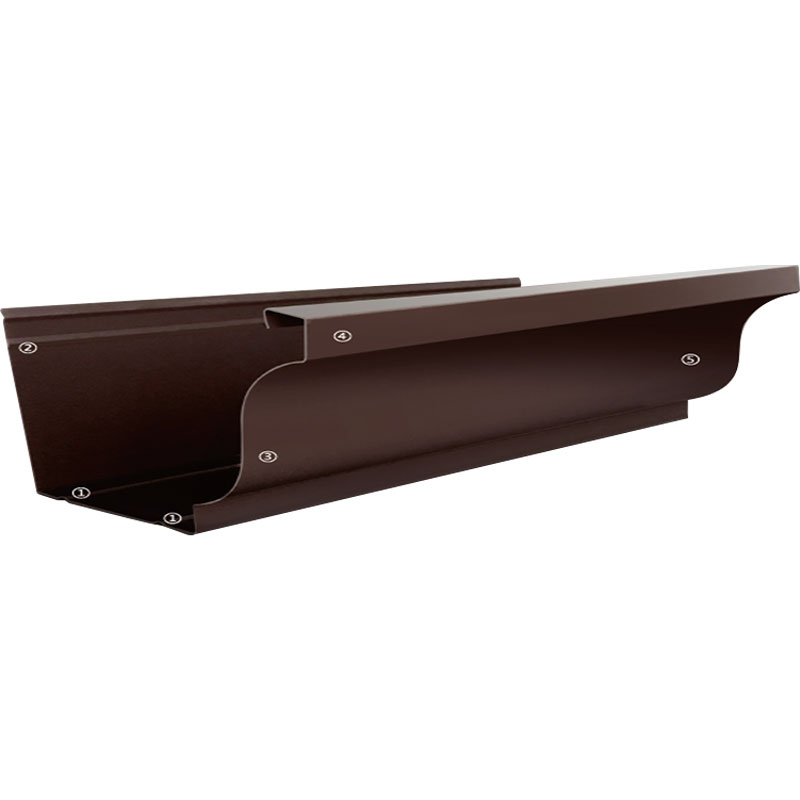
Many gutter failures are not material failures — they are design failures. Poorly planned systems develop chronic problems including water leakage at joints, overflow at corners, back-splash onto exterior walls, and the persistent dripping known as urinary eaves, where water clings to the underside of the gutter and runs down the fascia rather than into the downpipe.
The colored aluminum rain gutter system uses a systematic design approach that eliminates these problems through precision component engineering. Each element — gutter lengths, mitre corners, end caps, outlets, downpipe brackets, and joining sleeves — is dimensionally coordinated to create a sealed, continuous system. Joints use factory-formed profiles with rubber gaskets or sealant channels that compress under installation, creating watertight connections without field-applied sealants that can fail over time.
Installation Efficiency and Construction Benefits
Beyond performance, the systematic component design makes installation significantly faster and more straightforward than traditional site-formed gutter systems. Components arrive pre-cut and pre-finished, requiring only assembly and bracket fixing rather than cutting, bending, and painting on site. This makes it easy to install and construct, and the construction period is noticeably shorter compared to custom-fabricated alternatives.
The light weight of aluminum alloy components also reduces the number of installation personnel required and eliminates the need for heavy lifting equipment on residential projects. A complete gutter run of 20–30 meters can typically be installed by a two-person crew in a single day, including downpipe routing and outlet positioning.
For project managers and contractors, these installation characteristics translate directly into lower labor costs, reduced scaffolding time, and faster project handover — without any compromise in the quality or durability of the finished system.
Long-Term Value Compared to Alternative Gutter Materials
Initial purchase price rarely reflects the true cost of a rain gutter system over its service life. Vinyl gutters may cost less upfront but become brittle and crack in cold climates within 10–15 years. Galvanized steel gutters require repainting every 5–7 years to prevent rust progression. Copper performs exceptionally but at a material cost three to five times higher than aluminum.
The colored aluminum rain gutter system offers a compelling total-cost profile. With proper installation, aluminum systems routinely achieve service lives of 30–50 years in temperate and subtropical climates. The corrosion-resistant oxide layer, combined with the durable powder coat finish that resists severe cold and high temperatures, means the system requires no repainting and minimal maintenance throughout its operational life.
When the cost of replacement, repainting, and labor for alternative systems is factored in over a 30-year horizon, aluminum consistently delivers the lowest lifecycle cost of any commonly available gutter material — while simultaneously offering the widest range of profiles, colors, and customization options to suit any architectural requirement.